
Plants
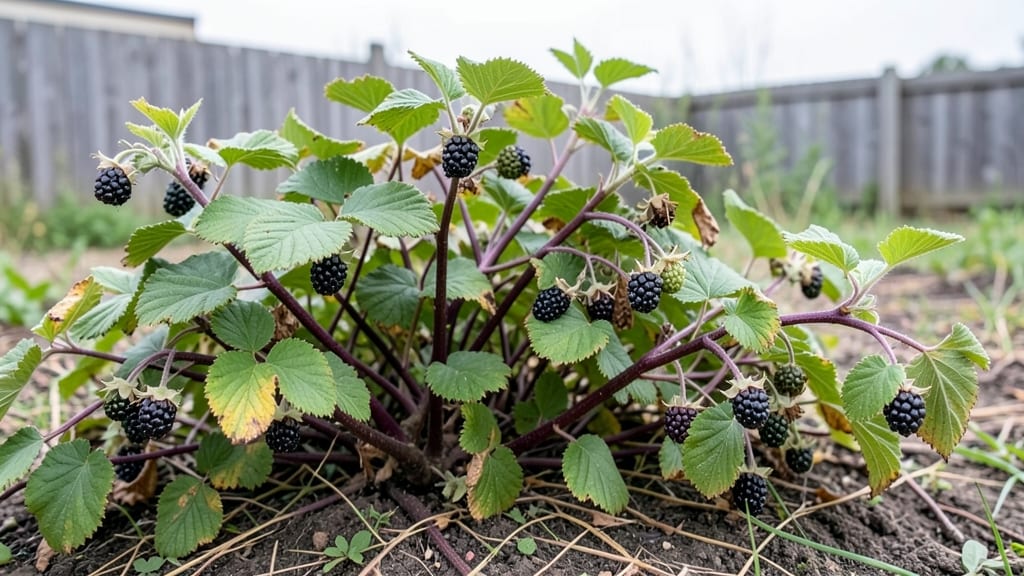
Identifying blackberry plants starts with their distinctive saw-toothed leaves and arching canes—traits that set them apart from raspberries and other brambles.
I’ve spent years telling the difference between these thorny plants, and the key is in the details: blackberry leaves have five to seven serrated leaflets that curve upward, while raspberries have three to five with a more open shape.
The canes themselves are another dead giveaway—blackberries grow long, woody, arching stems that trail along the ground, whereas raspberries are more upright.
Thorns and fruit shape are your next clues. Blackberry canes are densely armed with sharp, curved thorns, while raspberries tend to have fewer, straighter ones. As for the fruit, blackberries form in long clusters that ripen from the bottom up, turning deep purple-black when ready.
Raspberries, on the other hand, have hollow cores and separate easily from their stems—blackberries cling tightly. These differences matter because they dictate how you prune and care for your plants, so getting it right from the start saves headaches later.
Once you’ve mastered these basics, you’ll spot blackberries anywhere—even in the wild. The sweet, juicy fruit and the plant’s aggressive growth habit make it a favorite for gardeners, but knowing the varieties helps too.
Common types like Cheyenne, Triple Crown, and Natchez have slightly different leaf shapes or cane sizes, so keep an eye out for those nuances. With practice, you’ll identify them faster than you can say "thorn-free harvest."
Why does this matter? Because proper identification means better pruning, higher yields, and fewer pests. A misidentified plant could end up smothered by vines or starved of nutrients if you’re not giving it what it needs.
Now that you’ve got the visual cues down, you’re ready to cultivate like a pro—no more guessing games in the garden.
Root Causes of Misidentification
Misidentifying blackberry plants can be frustrating, especially when their traits resemble other brambles or even toxic look-alikes. Understanding the why behind common identification errors helps gardeners and foragers spot key differences. Here’s a breakdown of the most frequent pitfalls—and the science that explains them.
Blackberries often start as young canes that lack the distinctive features of mature plants. Their leaves, thorns, and fruit clusters can closely resemble those of raspberries, dewberries, or even wild roses in early development.
- Why it happens: Immature blackberry canes (called primocanes) have softer, lighter green leaves with fewer serrations (tooth-like edges) than mature foliage.
Their thorns may also be less pronounced, making them harder to distinguish from raspberry canes. - Science behind it: Blackberries (Rubus spp.) undergo heterophyllism—a phenomenon where leaf shape changes as the plant matures.
Young leaves are simpler, while older ones develop deeply lobed or serrated edges with a shiny, waxy coating (a trait called glaucousness). - Actionable tip: Wait until late summer or fall to identify blackberries.
Mature canes (floricanes) produce aggregate fruits (drupelets) in clusters, while primocanes grow upright without fruit until the next year.
Thorns are a primary ID marker for blackberries, but their appearance can vary wildly based on species, soil, and stress levels.
- Why it happens: Some blackberry varieties (like Rubus allegheniensis, or Allegheny blackberry) have long, curved thorns, while others (e.g., Rubus fruticosus agg.) may have shorter, straighter spines.
Poor soil or drought can also weaken thorn development, making plants look less "spiky." - Science behind it: Thorns in Rubus species are modified stems (axillary buds) that evolve as a defense mechanism.
Their shape is influenced by genetics and environmental stress—plants in nutrient-poor soil may produce fewer, weaker thorns. - Actionable tip: Compare thorns to raspberry canes, which have hollow, needle-like thorns (not solid like blackberry spines).
Run your finger along the cane—blackberry thorns feel hard and woody, while raspberry thorns can bend slightly.
Unripe blackberries can look purple, red, or even black—but their texture and clustering differ from other fruits like elderberries or huckleberries.
- Why it happens: Immature blackberries may appear small and glossy, mimicking wild grapes or mulberries.
Overripe ones can split open, exposing the yellowish core (a dead giveaway for blackberries). - Science behind it: Blackberries are aggregate fruits (many tiny drupelets fused together), unlike simple fruits (e.g., raspberries, which have hollow cores).
Their color shifts from green → red → deep black due to anthocyanin accumulation, a pigment sensitive to light and temperature. - Actionable tip: Check for fruit attachment—blackberries grow in pendulous clusters (hanging down), while raspberries stay upright on the cane.
Also, squeeze gently: blackberries feel firm but yield slightly, while elderberries are softer and juicier.
Blackberries crossbreed easily with raspberries and dewberries, creating hybrids that defy simple ID rules.
- Why it happens: Pollinators like bees and birds transfer pollen between Rubus species, leading to intermediate traits.
For example, a blackberry-raspberry hybrid might have: - Blackberries’ thorny canes but raspberries’ hollow cores. - Dewberry’s low-growing habit but blackberry’s large fruit clusters. - Science behind it: Rubus species are highly polyploid (multiple chromosome sets), making hybrids fertile and stable.
This genetic flexibility is why some "blackberries" in the wild are actually loganberries or boysenberries. - Actionable tip: If a plant has both blackberry-like thorns AND raspberry-like fruit, it’s likely a hybrid. Check the roots—blackberries spread via underground runners (rhizomes), while raspberries have shallow root systems.
Drought, pests, or fungal infections can alter leaf shape, color, and growth patterns, making plants look like entirely different species.
- Why it happens: - Drought stress → Leaves curl and darken, resembling blackberry rust (a fungal disease). - Spider mites → Yellow stippling on leaves, similar to nutrient deficiency. - Powdery mildew → White coating that can make leaves look bleached or diseased. - Science behind it: Blackberries are susceptible to abiotic (non-living) and biotic (living) stressors.
For example, low humidity triggers powdery mildew (Sphaerotheca macularis), while overwatering causes leaf yellowing (chlorosis). - Actionable tip: Inspect the undersides of leaves—pests like Japanese beetles or spider mites leave distinct damage patterns.
Healthy blackberry leaves should be dark green, glossy, and serrated.
Blackberries aren’t a single species—they’re a genus with hundreds of cultivars, each adapted to local climates.
- Why it happens: - Northern blackberries (e.g., Rubus occidentalis) have smaller, redder fruit and hardier canes. - Southern blackberries (e.g., Rubus argutus) produce larger, sweeter berries but with longer thorns. - Trailing vs. erect growth habits vary by species—some sprawl like dewberries, while others grow upright like boysenberries. - Science behind it: Blackberries evolved in temperate zones, and their traits reflect natural selection pressures.
For example, mountain blackberries develop thicker canes to withstand wind, while lowland varieties prioritize fruit size over thorn density. - Actionable tip: Cross-reference with local plant databases (e.g., USDA PLANTS or state agricultural extensions).
If you’re in the Pacific Northwest, Rubus ursinus (Pacific blackberry) looks very different from Rubus allegheniensis (common in the Midwest).
Quick fixes for common blackberry issues
Identifying your blackberry plant is just the first step—keeping it thriving is where the real work begins! Whether your Rubus fruticosus is struggling with pests, diseases, or environmental stress, these practical solutions will help you revive your plant and prevent future problems.
Below, we’ve mapped common issues to easy fixes, complete with prevention tips to keep your blackberries lush and productive.
Cause: Too many canes competing for nutrients, poor pruning, or lack of sunlight. Fix:
- 🔪 Prune aggressively in late winter/early spring – Remove ⅓ of the oldest canes at the base to encourage new growth. Thin out crowded canes to improve airflow.
- 🌱 Space new plants 4–6 feet apart – Blackberries need room to breathe (and grow strong!).
- ☀️ Ensure 6–8 hours of sunlight daily – Move potted plants to a sunnier spot if needed.
💡 Prevention Tip: Train canes along a trellis or wire support to avoid sprawling and tangling. This also makes harvesting easier!
Cause: Soft-bodied pests suck sap, weakening plants, while beetles chew leaves and fruit. Fix:
- 💦 Blast off pests with water – Use a strong hose spray to knock off aphids and spider mites (especially on undersides of leaves).
- 🍋 Apply neem oil or insecticidal soap – Spray in the evening to avoid harming bees. Reapply every 5–7 days.
- 🕷️ Handpick Japanese beetles – Drop them into soapy water (they’re easy to spot with their shiny green bodies!).
💡 Prevention Tip: Encourage natural predators like ladybugs and lacewings by planting companion flowers (e.g., marigolds, dill) nearby.
Cause: High humidity, poor airflow, or wet foliage from overhead watering. Fix:
- ✂️ Prune for airflow – Remove dense or crossing canes to reduce humidity pockets.
- 💧 Water at the base, not the leaves – Use drip irrigation or soaker hoses to keep foliage dry.
- 🌿 Spray with baking soda mix – Combine 1 tsp baking soda, 1 tbsp vegetable oil, and 1 quart water. Spray every 7–10 days.
- 🍄 For severe cases, use fungicide – Copper fungicide or sulfur sprays work well (follow label instructions).
💡 Prevention Tip: Space plants widely and avoid watering late in the day to let leaves dry overnight.
Cause: Insufficient pollination, nutrient deficiencies, or improper pruning. Fix:
- 🐝 Attract pollinators – Plant bee-friendly flowers (e.g., lavender, clover) nearby. If bees are scarce, hand-pollinate with a small brush.
- 🌱 Feed with balanced fertilizer – Use a 10-10-10 or organic compost in early spring. Avoid high-nitrogen fertilizers (they boost leaves, not fruit!).
- 🍓 Thin fruit clusters – Remove some berries early to reduce competition for resources, leading to larger, sweeter fruit.
💡 Prevention Tip: Prune in late winter to remove dead wood and encourage strong, fruiting canes. Blackberries produce best on second-year canes—don’t cut them all!
Cause: Extreme temperatures or inconsistent watering. Fix:
- 💧 Mulch heavily – Use 2–3 inches of straw or wood chips to retain moisture and regulate soil temperature.
- 🌞 Provide shade in summer – Use shade cloth (30–50%) if temps exceed 90°F (32°C).
- ❄️ Protect from frost – Cover young plants with frost cloth in late fall. Established plants tolerate cold well but may need winter mulch in harsh climates.
💡 Prevention Tip: Blackberries love well-draining soil. Amend clay soil with compost or sand to prevent root rot.
Cause: Overwatering, compacted soil, or planting too deep. Fix:
- 🚰 Check drainage – If soil stays soggy, raise beds or mix in perlite/sand.
- 🌿 Transplant carefully – Dig a hole twice as wide as the root ball but no deeper. Gently loosen roots before planting.
- 💧 Water deeply but infrequently – Let the top 1–2 inches of soil dry out between waterings.
💡 Prevention Tip: Plant blackberries in spring (not fall) to give roots time to establish before winter. Avoid soggy spots—roots need oxygen!
With these targeted fixes, your blackberry plant should bounce back stronger than ever. Remember, consistency is key—whether it’s pruning, watering, or pest control, a little effort now saves big headaches later. Happy growing! 🌿🍇
Frequently asked questions
How do I tell the difference between blackberries and raspberries?
Look at the fruit and canes: blackberries grow in long clusters that hang down, while raspberries form upright clusters that separate easily from the stem. Blackberry canes are thorny and arching, while raspberry canes are more upright with fewer thorns. The leaves also differ—blackberries have 5-7 serrated leaflets, while raspberries have 3-5.
Can I identify a blackberry plant without seeing the fruit?
Yes! Focus on the leaves and canes. Blackberry leaves have 5-7 pointed, saw-toothed leaflets that curve upward. The canes are woody, arching, and covered in sharp, curved thorns. Young canes (primocanes) grow upright, while older fruiting canes (floricanes) trail along the ground.
What are the most common blackberry varieties I might find in my garden?
Popular types include Cheyenne (thornless, cold-hardy), Triple Crown (large fruit, disease-resistant), and Natchez (semi-evergreen, sweet flavor). Allegheny blackberries are native and have long, curved thorns, while Pacific blackberries (common in the West) have smaller, redder fruit.
Why does my blackberry plant look like a raspberry but has thorns?
It might be a blackberry-raspberry hybrid! These crossbreeds often have thorny canes like blackberries but hollow cores like raspberries. Check the roots—blackberries spread via underground runners (rhizomes), while raspberries have shallow root systems. If in doubt, wait for fruit to confirm.
Can I use an app to identify my blackberry plant?
Yes! Apps like PictureThis, PlantNet, or iNaturalist use photo recognition to ID plants. Upload clear images of leaves, thorns, and canes—avoid blurry shots. For best results, include both young and mature growth since leaf shapes change as the plant ages.